Auto Insurance Shopping and New Policy Growth Registers “Warm” on the Q1 LexisNexis® U.S. Insurance Demand Meter
PR Newswire
ATLANTA, May 12, 2026
Shopping and switching growth increases were more modest in the first quarter of 2026, but historic activity levels continued
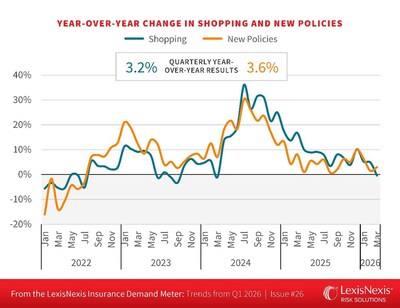
ATLANTA, May 12, 2026 /PRNewswire/ — U.S. auto insurance shopping and new business growth shifted from “Hot” to “Warm” in the first quarter of 2026 in the latest U.S. Insurance Demand Meter from LexisNexis® Risk Solutions. While year-over-year (YOY) shopping growth decreased to 3.2% and new policy growth dropped to 3.6%, shopping was still significantly elevated relative to historic levels, even with Demand Meter readings cooling.
Key Takeaways
- Shopping Growth Shifts to “Warm”: Quarterly year-over-year U.S. auto policy shopping growth slowed to 3.2% in Q1 2026, even turning negative in March, which was down from the increase of 6.9% in Q4 2025.
- New Policy Growth Returns to “Warm”: New policy growth reached 3.6% for the quarter, down from the 7.1% increase in Q4 2025, which sat closer to levels seen in mid-2025.
- Older Shoppers Continue to Lead Growth: Policyholders aged 66 and older led all age cohorts for the 13th consecutive quarter, with shopping growth rising 7.1% year-over-year.
- Direct Channel Remains Strongest, Exclusive Channels Continue to Grow: The direct channel has the highest growth at 9.4%, while the exclusive agent channel grew 5.6%, up from 5.3% in Q4 2025, and the independent agent channel contracted -7.9%.
- Annual Shop Rate Reaches New High: At the end of Q1, 47.3% of policies-in-force had been shopped at least once within the previous 12 months, the highest rate recorded since the Insurance Demand Meter began tracking in 2020.
Download the latest U.S. Insurance Demand Meter.
Market Activity and Consumer Behavior Stabilizing After Elevated Growth
While 47.3% of policies-in-force had been shopped at least once in the past 12 months, year-over-year growth for both shopping and new business decelerated suggesting that consumer shopping behavior is stabilizing. The slowing is likely the result of carriers implementing rate decreases and diminished vehicle sales. Stabilization is also reflected in the recent flattening of retention rates among auto policy holders. In March, vehicle sales contrasted significantly to March of 2025, when many consumers purchased vehicles ahead of potential tariffs that drove strong additional shopping activity.
Rate Revisions Continue to Shape Behavior
Rate revisions for U.S. auto insurance policies that went into effect in Q1 2026 reflected a continued shift in market conditions. Among all rate revisions 35% were decreases, 39% were increases and 26% were rate-neutral. The aggregate rate change for the quarter was -1.1%, with decreases averaging -5.1% and average increases reaching 3.9%1. Those percentages closely mirrored the activity among the top 25 auto carriers, which showed a similar pattern: 42% of rate revisions were decreases, 26% were increases and 30% were rate-neutral, bringing average decreases to -5.0% and average increases to 4%2.
While overall industry growth remained positive, rate decreases are less likely to trigger consumers to shop than rate increases.
Direct and Exclusive Channel Growth Points to Uneven Activity
The direct channel continued to lead all channel growth in Q1 at 9.4%. At the same time, the exclusive agent channel also made gains, growing 5.6%. This represents an improvement from the 5.3% growth in the final quarter of 2025 and marks the second consecutive quarter with a positive growth rate for this channel. On the other hand, the independent agent channel experienced a more significant downturn in Q1, dropping -7.9%, a further decline from the -0.1% decrease noted in Q4 2025. Non-standard shoppers also contributed to the broader growth slowdown, dropping -5.8% in Q1 after growing 12.2% in Q4 2025. For non-standard shoppers, Q1 marked its first negative quarterly growth rate since Q4 2023, potentially influenced by inflation, affordability pressures and the total cost of vehicle ownership. Conversely, standard shoppers remained closer to the overall market trend, with quarterly growth increasing 3.9% year-over-year, but down from 6.5% increase in growth from the last quarter.
Shoppers 66 and Over Continue to Lead Shopping
Despite decelerations in growth rates across customer activity, policyholders aged 66 and older exhibited the strongest growth, with a quarterly increase of 7.1% year over year. Other age cohorts showed more modest changes, including a -0.3% decline among shoppers aged 26 to 35; a 2.3% increase among those ages 36-to-45; and a 3.4% increase among both the 45-to-55 and 56-to-65 age groups.
“As auto insurance shopping growth begins to level off loyalty can be what separates temporary wins from sustainable growth. Insurers that invest now in retaining hard-earned customers will likely be better positioned as the market shifts from rapid expansion to measured momentum,” said Jeff Batiste, senior vice president and general manager, U.S. auto and home insurance, LexisNexis Risk Solutions. “In this transitioning market, once loyal, profitable customers could be up for grabs. Insurers who recognize this can respond with compelling offers and personalized premiums to edge out competition.”
Q1 State Growth Standings
Only four states recorded shopping growth of at least 10% or greater in Q1, compared to 11 states in Q4 2025 that reached the mark. New York led all states with 11.8% growth, followed by California at 10.4%, Wyoming at 10.1% and Louisiana at 10%. New Jersey fell just below the threshold at 9.7%.
Growth patterns seen throughout the country were likely tied in large part to rate revisions. While many states experienced decreases, states like New York and California implemented increases that built on the increases from 20253. In these states where rate filing approvals may take longer, the speed of adjustments taking effect is impacted, which can affect shopping.
Looking Ahead
Customer retention has been impacted by premium increases motivating consumers to shop. For the 13th consecutive quarter, policyholders aged 66 and older, typically an insurer’s higher lifetime value customers, are exhibiting a higher growth rate than younger shoppers. While rate decreases may impact market activity in new ways, even slowing growth rates, longer-tenured customers may be re-writing the rules of engagement for loyalty when it comes to shopping and channel preferences.
LexisNexis U.S. Insurance Demand Meter
The LexisNexis® U.S. Insurance Demand Meter is a quarterly analysis of shopping volume and frequency, new business volume and related data points. LexisNexis Risk Solutions offers this unique market-wide perspective of U.S. consumer shopping and switching behavior based on its analysis of consumer shopping transactions since 2009, representing nearly 90% of the universe of U.S. insurance shopping activity.
About LexisNexis Risk Solutions
LexisNexis® Risk Solutions provides customers with information-based analytics and decision tools that combine public and industry-specific content with advanced technology and algorithms to assist them in evaluating and predicting risk and enhancing operational efficiency. Headquartered in metro Atlanta, Georgia, the company has offices throughout the world, serves customers in more than 190 countries and territories and is part of RELX. For more information, please visit LexisNexis Risk Solutions.
|
________________ 1 S&P Global Market Intelligence (and its affiliates, as applicable), April 1, 2026 |
|
2 Ibid. |
|
3 Ibid. |
Media Contacts:
Annalysce Baker
LexisNexis Risk Solutions
Phone: +1 678.436.1579
annalysce.baker@lexisnexisrisk.com
 View original content to download multimedia:https://www.prnewswire.com/news-releases/auto-insurance-shopping-and-new-policy-growth-registers-warm-on-the-q1-lexisnexis-us-insurance-demand-meter-302768916.html
SOURCE LexisNexis Risk Solutions