UTulsa biochemistry researchers advance fight against brain cancer
PR Newswire
TULSA, Okla., May 11, 2026
TULSA, Okla., May 11, 2026 /PRNewswire/ — According to the National Brain Tumor Society, approximately 1.3 million Americans are living with a brain tumor. The relative survival rate is only 34.8%, and 18,350 people in this country are expected to die from one of its forms this year alone.
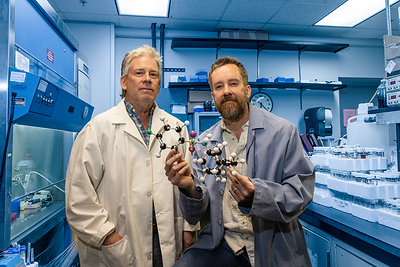
Current treatments for brain cancer usually involve surgery followed by radiation and chemotherapy. At The University of Tulsa’s Oxley College of Health & Natural Sciences, Associate Professors Angus Lamar and Robert Sheaff are leading the charge to improve the potency of chemotherapy and patient outcomes. In fact, UTulsa recently filed a patent for their compounds as anticancer agents.
“Chemotherapeutic options are limited because of the heterogeneity of brain cancer cells and the need for these drugs to cross the blood-brain barrier (BBB),” said Lamar. “In order for a compound to be BBB-permeable, several features of the molecule must be taken into consideration, a fact that makes the design of potential drugs highly challenging.”
The two first collaborated on the creation of analog compounds that are similar to memantine – a drug used to treat Alzheimer’s and is known to cross the barrier. After developing new compounds, they test them to determine their potential as anticancer agents.
With funding from the Oklahoma Center for the Advancement of Science and Technology, they created a new organic reaction that enabled them to install sulfonamide functional groups into specific locations of organic molecules. Since then, Lamar’s research group installed the sulfonamide group into the memantine core to create more than 30 new memantine analogs they predict can cross the barrier. Following that work, the Sheaff lab tested the compounds for anticancer activity against a glioblastoma cell line, observing cytotoxicity significantly higher than temozolomide, the frontline chemotherapeutic for brain cancer.
Lamar and Sheaff shared their findings in Results in Chemistry, a scholarly journal.
“In the Results in Chemistry article, we documented our work testing compounds as inhibitors of metabolic energy production, which is another way to target cancer,” Sheaff said. “Our key discovery was that one of the analogs has high selectivity and potency for glioblastoma cells but no observable effect against normal – that is, noncancerous – cells under the same experimental conditions. We are very excited about this being a possible drug that can cross the BBB and target cancerous brain cells while leaving healthy cells unharmed.”

 View original content to download multimedia:https://www.prnewswire.com/news-releases/utulsa-biochemistry-researchers-advance-fight-against-brain-cancer-302767616.html
SOURCE The University of Tulsa