The strain of rising prices and pressures unique to military life – frequent moves, costs of living near military installations, and spouse unemployment – are creating pressure points that impact the financial readiness of military families, according to The USAA Educational Foundation’s inaugural State of Personal Finance in the Military Community Report.
This press release features multimedia. View the full release here: https://www.businesswire.com/news/home/20260511451770/en/
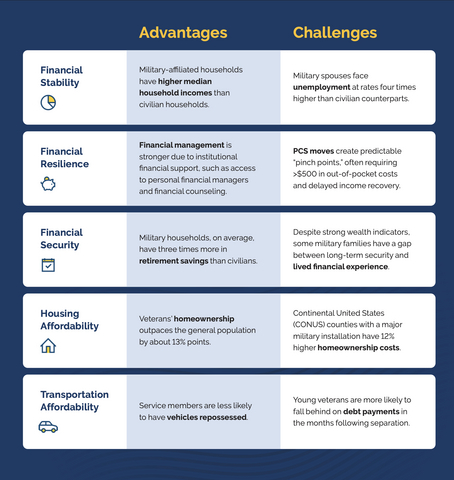
Key takeaways from USAA Educational Foundation Report
The report, which provides a comprehensive, data-driven view into the factors shaping personal finance for currently serving, veterans and families, highlights the dual realities of military life, where these headwinds may limit growth from higher incomes, savings, and retirement assets. Many of these pressures are recurring and predictable, such as Permanent Change of Station (PCS) moves or lower resilience to cost-of-living changes among younger service members, creating opportunities where stronger financial planning and action can drive better outcomes.
“This report reflects the financial realities of military life as our service members live it, where we can see financial strain among many families and the positive impacts that financial readiness can have,” said David Evetts, President, USAA Educational Foundation. “In many ways, the data shows the positive economic impacts of military service, while highlighting the need to address persistent issues like high spouse unemployment and PCS costs to maximize well-being. Together, we can turn these insights into action that helps military families build lasting financial security.”
|
|
Advantages |
Challenges |
|
Financial Stability |
Military-affiliated households have higher median household incomes than civilian households. |
Military spouses face unemployment at rates four times higher than civilian counterparts. |
|
Financial Resilience |
Financial management is stronger due to institutional financial support, such as access to personal financial managers and financial counseling. |
PCS moves create predictable “pinch points,” often requiring >$500 in out-of-pocket costs and delayed income recovery. |
|
Financial Security |
Military households, on average, have three times more in retirement savings than civilians. |
Despite strong wealth indicators, some military families have a gap between long-term security and lived financial experience. |
|
Housing Affordability |
Veterans’ homeownership outpaces the general population by about 13% points. |
Continental United States (CONUS) counties with a major military installation have 12% higher homeownership costs. |
|
Transportation Affordability |
Service members are less likely to have vehicles repossessed. |
Young veterans are more likely to fall behind on debt payments in the months following separation. |
“Military life provides significant financial advantages, from steady pay and comprehensive retirement plans to greater access to institutional support,” Evetts continued. “Financial readiness is improving, but it’s also uneven. We want to close that gap and ensure that every military family feels optimistic about their future.”
Findings from the State of Personal Finance in the Military Community Report also align with broader research across the military and veteran community. Recent data from organizations including Wounded Warrior Project and Blue Star Families show many military households continue to face financial strain, particularly among younger enlisted service members and veterans navigating transition from military service.
For example, nearly half of respondents in a recent Wounded Warrior survey said they were living paycheck-to-paycheck and had little-to-no confidence that they could find $1,000 to cover an emergency expense. Increased cost of goods, unexpected financial hardship and “not making enough money” were among the top reported reasons for financial struggle. This burden is amplified among younger enlisted, with over 20% of E1-E5 service members reporting they were finding it difficult to get by, according to Blue Star Families.
The full report is available on The USAA Educational Foundation’s website: https://usaaef.org/wp-content/uploads/2026/04/State-of-Personal-Finance_USAA_EF.pdf
About the report
Data for the report was compiled through The Military & Veteran Economic Security Tracker (MVEST). MVEST is a national data and analytics platform developed by The USAA Educational Foundation. The vision of MVEST is to provide an objective, comprehensive view of the financial health and wealth of transitioning service members, veterans, and their families.
Anchored in rich data profiling households across the U.S., MVEST makes it possible to evaluate population cohorts and communities by benchmarking key determinants and outcomes of financial health. Additional data were compiled through public reports from Blue Star Families, the Military Family Advisory Network, Department of Defense and other organizations.
About The USAA Educational Foundation
Founded in 1986, The USAA Educational Foundation is a nonprofit 501(c)(3) organization that provides unbiased financial education to the military community. The Foundation does not endorse commercial products or services and works to lead and inspire actions that improve financial readiness for service members, veterans, and their families.
View source version on businesswire.com: https://www.businesswire.com/news/home/20260511451770/en/
Media gallery