Deloitte: As Rising Costs Slow Summer Travel to Six-Year Low, Travelers Plan to Spend More
PR Newswire
NEW YORK, May 19, 2026
Fewer Americans plan summer travel, but those taking to the sky and road are expected to dig deep to navigate pricing pressures
NEW YORK, May 19, 2026 /PRNewswire/ —
Key takeaways
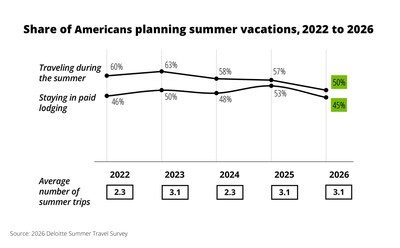
- 45% of Americans plan to take a summer vacation with a stay in paid lodging, the lowest figure in six years. Costs are keeping others home, as one-third of non-travelers say travel is too expensive (32%), and they cannot afford it (35%).
- Surveyed Americans who are willing to travel are willing to spend: Travelers expect to spend an average of $4,069 on their longest summer trip, up 17% from last year.
- Travelers surveyed are expected to absorb higher costs without compromising experience. About 1 in 4 travelers plan to significantly raise trip budgets, up five percentage points from 2025 and mostly due to higher airline and lodging prices.
- Shifting demographics are shaping summer travel trends. Younger travelers plan to spend more than last year and travel more often. They also plan to lean into GenAI and other tech to plan their itineraries.
- Laptop lugging continues to redefine travel plans, as one-third (34%) of travelers surveyed plan to work during their longest summer trip, up from 23% in 2025.
Why this matters
While the cost of travel may keep some Americans grounded this summer, those planning trips are determined to pack their itineraries, even if it means spending more. In its “2026 Summer Travel Survey” report, “Flight or Fold: Travelers Navigate Pricing Pressure,” Deloitte examines the trends and preferences that are expected to shape the upcoming summer travel season, and how the price of travel may impact the landscape.
Travel’s personal value takes off
While the cost of travel is keeping some home, those Americans getting away are willing to dig deeper to enjoy the trips they value. This summer, 45% of Americans plan to travel this summer and stay in paid lodging, the lowest percentage in the last six years. However, those who do plan to travel expect to take the same number of trips, travel for more days and spend more on their experiences.
- Travelers surveyed plan to take an average of 3.1 summer trips, the same as last year, and increase budgets for their longest trip to $4,049 — 17% higher than in 2025. Younger travelers expect to travel more: 3.4 summer trips for Gen Z (up 19% from 2025) and 3.3 for millennials (up 5%).
- For those choosing not to travel this summer, financial pressure is the main reason. General financial concerns have decreased slightly, as 35% say they can’t afford it, down from 2025 (38%). Meanwhile, travel costs specifically have inched up: 32% say travel is too expensive right now, slightly more than last year (30%). Concerns about travel disruption have nearly doubled but remain small (11% of non-travelers versus 6% in 2025) and feeling unsafe while traveling rose from last year (11% vs. 8%).
- Most Americans (82%) report some impact from everyday expenses on their ability to spend on travel. But many characterize that impact as slight or moderate. Those earning less than $100K a year are more than twice as likely to report significant impact as those earning more than $200K.
- Travel incidence is down across income levels, but most pronounced among households earning less than $100K per year (down 8 percentage points year-over-year), compared to a decrease of 4 percentage points each for middle- ($100K-200K) and high-income earners (more than $200K).
- Budget increases are going towards enhanced trip experiences. Longer trips remain the top upgrade (40%), but those planning to upgrade comfort is increasing, such as an upgraded airfare class (23% vs. 20% in 2025), better lodging location (29% vs. 25%) or more luxurious lodging (26% vs. 24%).
- Travelers’ financial perceptions have improved: Forty-two percent of summer travelers say their financial situation is better this year, up from 34% who said the same in 2025. Gen Z and millennials say their financial situation has improved vs 2025 (54% for Gen Z and 58% for millennials). Meanwhile, the share of travelers who say their financial situation is worse than a year ago has declined from 25% last year to 17% this year.
- Across the season, average trip length is expected to be up slightly this year: 38% of trips are planned for three nights or fewer, compared to 41% last year. However, when looking at their longest planned trip of the summer, some are cutting back: 42% of travelers say their longest trip will last a week or more, down from 45% in 2025.
- While most travelers surveyed (77%) say their longest trip will fall before the end of August, the share of all summer trips taking place post-Labor Day (Sept. 7) has climbed from 12% in 2022 to 20% in 2026.
Comfort and experience shape spending
Those planning to travel this summer are willing to spend, with travel intent across core travel product categories holding steady year-over-year. Despite cost, Americans still plan to stay in paid lodging, and they’re also more open to upgrade flights. This comes as slightly fewer travelers plan to stay with friends and family this summer (37% vs. 39% in 2025).
- The number of Americans surveyed planning to stay in hotels at least once during the summer travel season is steady (81% in 2026 vs. 80% in 2025) while private rentals is expected to see a slight uptick (29% vs. 25%).
- Among those surveyed and planning to fly at least once during the summer, 61% plan to take a domestic flight (up from 58% in 2025), and nearly one-third (32%) plan to fly internationally (up from 27% in 2025).
- Price has declined in importance when it comes to picking an airline (from 65% in 2025 to 60% in 2026), while reliability rises (from 44% to 51%). Similarly, price sensitivity declined in lodging choices (from 55% in 2025 to 52%).
- With a higher-income traveling population and a willingness to spend on comfort, air travelers expect to purchase more first class or business class fares (up 4 percentage points year-over-year) and tickets with upgrades (up 6 percentage points year-over-year) for their marquee summer trips.
- Luxury travelers (43%) and millennials (32%) are among the groups showing high intent to travel internationally on their marquee trips. Overall, Europe (45%) remains the international destination of choice, while the balance of trips within North America shifts toward Canada (up 4 percentage points).
- While overall interest across accommodation types stays steady, higher-income travelers (those earning over $200k) are leaning more towards service and on-property amenities for their marquee trips, increasing interest this year in full-service hotels (59% in 2026 vs. 54% in 2025) and destination resorts (23% vs. 14%).
- Compared to 2025, travelers show a bit more hesitancy to complete bookings in advance, a possible sign of price sensitivity. Among respondents, 35% of marquee trips are fully booked, down from 39% last year. Middle income earners ($100K -199K) surveyed exhibit the biggest booking progress gap (37% fully booked vs. 45% in 2025).
- About 8 in 10 travelers (78%) are members of at least one travel provider loyalty programs. Hotel loyalty programs have the highest share (55%) followed closely by airlines (51%).
- The figure for surveyed travelers who plan to take a road trip is down this year, at 66% compared to 71% last year.
Key quote
“Amid pricing pressures, those who are packing their bags this summer intend to spend, indicating that many are putting a premium on experiences. Providers can capitalize on this opportunity by focusing on enhancing the travel experience through upgrades and partner offerings. Those who are traveling have already decided it’s worth the investment, so leaning into the emotional connection to enhance vacation’s value could be a differentiator this summer.”
— Kate Ferrara, vice chair and U.S. transportation, hospitality and services sector leader
Shifting demographics map out new trends
Millennials are major shapers of travel demand this year, representing almost a third of travelers (31% vs. 29% in 2025).
- Short form video platforms are helping younger travelers plan itineraries: Among those surveyed, Gen Z makes up the largest generation leveraging the content in travel planning (42% vs. 23% overall), followed by millennials (33%).
- Overall adoption of GenAI to plan travel is up year-over-year (25% in 2026 vs. 15% in 2025), and millennials plan to use the technology (36%) more than other generations.
- When it comes to luxury travel, millennials and Gen Z lead intent: Nearly 4 in 10 (38% for Gen Z and 40% for millennials) are planning luxury stays throughout 2026.
- Surveyed millennials are the most likely laptop luggers this season, with 57% planning to work during their longest trip.
- Over 80% of Gen Z and millennial laptop luggers surveyed say that working remote has affected their travel habits, especially when it comes to trip length and spontaneity.
Key quote
“New generations are shifting the leisure travel landscape. Whether it’s turning to tech for itinerary planning or leaning into luxury bookings, these are trends the industry can tap into as they look to capture and build loyalty with younger travelers. Brands looking to capture these younger travelers’ attention should consider what’s driving these up-and-coming travelers to return year after year.”
— Eileen Crowley, U.S. transportation, hospitality and services leader
The Deloitte “2026 Summer Travel Survey” is based on a survey of 4,003 Americans fielded between April 2 and April 9.
About Deloitte
Deloitte provides industry-leading audit, consulting, tax, and advisory services to many of the world’s most admired brands, including nearly 90% of the Fortune 500® and more than 9,000 U.S.-based private companies. At Deloitte, we strive to live our purpose of making an impact that matters for our people, clients, and communities. We bring together distinct talents, technologies, disciplines, and an ecosystem of alliances to help tackle today’s most complex business challenges and drive long-term progress. Deloitte is proud to be part of the largest global professional services network serving our clients in the markets that are most important to them. Bringing more than 180 years of service, our network of member firms spans more than 150 countries and territories. Learn how Deloitte’s approximately 470,000 people worldwide connect for impact at www.deloitte.com.
Deloitte refers to one or more of Deloitte Touche Tohmatsu Limited, a UK private company limited by guarantee (“DTTL”), its network of member firms, and their related entities. DTTL and each of its member firms are legally separate and independent entities. DTTL (also referred to as “Deloitte Global”) does not provide services to clients. In the United States, Deloitte refers to one or more of the US member firms of DTTL, their related entities that operate using the “Deloitte” name in the United States, and their respective affiliates. Certain services may not be available to attest clients under the rules and regulations of public accounting. Please see www.deloitte.com/about to learn more about our global network of member firms.

 View original content to download multimedia:https://www.prnewswire.com/news-releases/deloitte-as-rising-costs-slow-summer-travel-to-six-year-low-travelers-plan-to-spend-more-302775452.html
SOURCE Deloitte

Media gallery