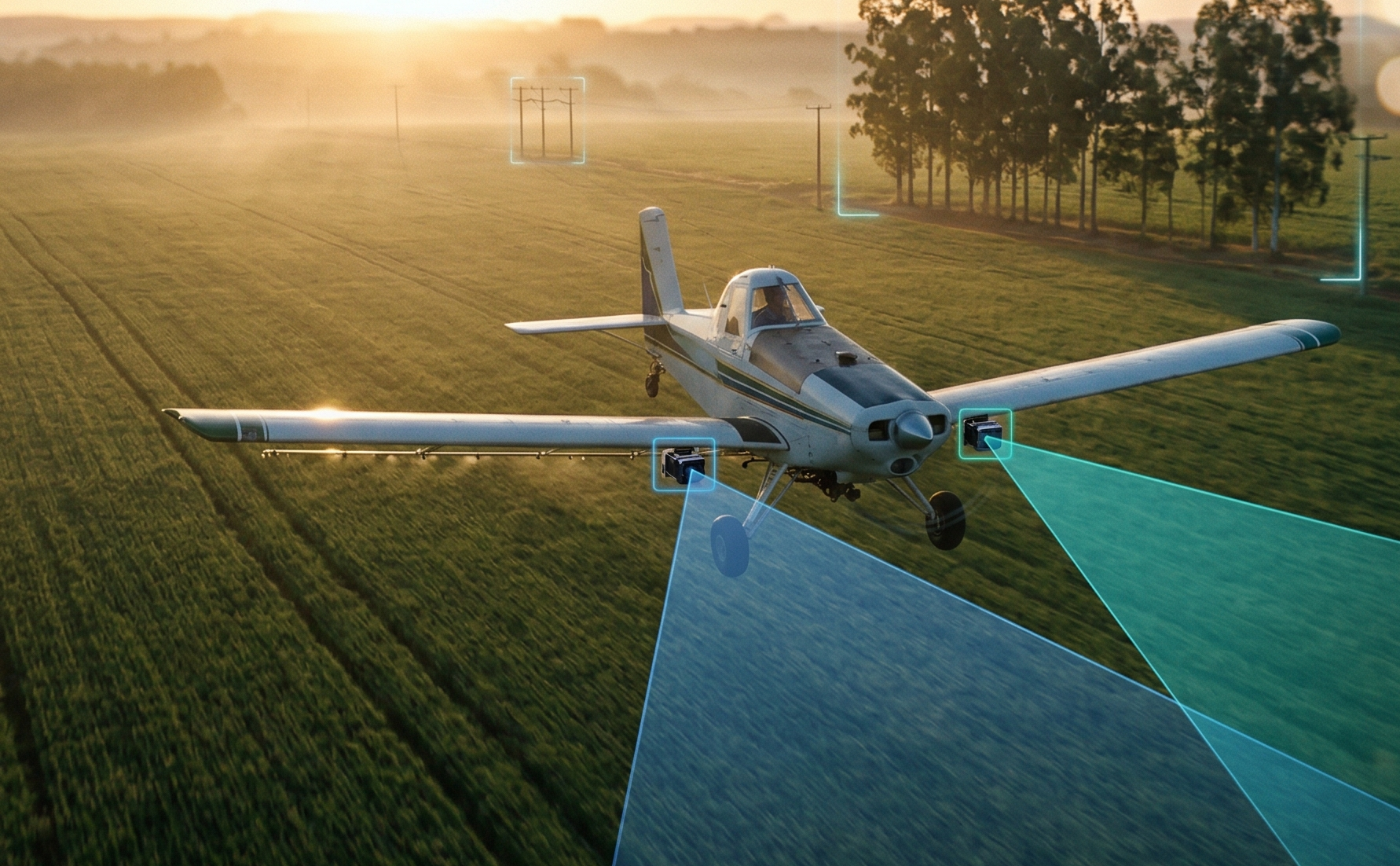
Ultrawide-baseline stereo vision delivers 1,000-meter obstacle detection for low-altitude aviation, including power lines and poles that radar and LiDAR miss
BOSTON, MA, UNITED STATES, May 19, 2026 /EINPresswire.com/ — NODAR, the ultrawide-baseline stereo vision company, has announced the commercial availability of FlightView, a real-time 3D collision warning system for fixed-wing aircraft and unmanned aerial vehicles (UAVs). Built on NODAR’s Hammerhead platform, FlightView detects obstacles at ranges up to 1,000 meters and generates a complete depth map of the flight environment including thin hazards such as power lines and poles at ranges up to 250 meters, a class of obstacle where radar and LiDAR consistently fall short.
Low-altitude flight exposes aircraft to a range of hazards including terrain, structures, wires, and other aircraft that demand long detection ranges and fast, reliable warnings. Existing sensor technologies either lack the range needed at practical size and weight, or have insufficient resolution to detect thin obstacles. FlightView addresses both limitations with dense, per-pixel 3D sensing that requires no laser emitter, no moving parts, and no RF emissions.
“The growth in low-altitude operations like UAVs and agricultural aircraft is outpacing the sensing technology available to keep them safe. Radar and LiDAR were designed for different problems at different scales. FlightView was built specifically for what low-altitude flight actually encounters,” said Leaf Jiang, CEO and Founder of NODAR. “Every other sensing approach in this space forces a tradeoff between longer range and broader coverage of what you can actually detect. You get long range or you get thin-obstacle detection, not both. Stereo vision gives you both by virtue of high-resolution cameras, and our autocalibration is what makes it work on a vibrating airframe.”
How FlightView Works
FlightView uses ultrawide-baseline stereo cameras and a patented per-frame autocalibration algorithm that continuously corrects stereo alignment under engine vibration, airframe flex, and temperature shifts with no manual recalibration required. The system produces 50 million depth measurements per second on an onboard compute unit.
Detected obstacles are evaluated against the aircraft’s current trajectory and speed to compute time-to-collision. When a threshold is exceeded, an audible warning triggers in the cockpit automatically. A visual overlay via HDMI displays detected objects with real-time distance labels on a cockpit-mounted display.
Key Capabilities
∙1,000-meter detection range for large obstacles including buildings, trees, other aircraft, and vehicles
∙250-meter detection of power line structures and poles
∙Dense per-pixel depth output at 50 million measurements per second with no interpolation gaps
∙Continuous per-frame autocalibration with no manual intervention required
∙IP67-rated cameras
∙Open integration via C++, Python, and ROS2 APIs; 10 Gb Ethernet output to user computer
Availability and Integration
FlightView is available now as a turnkey reference system based on the NODAR Hammerhead Reference Design, or as a software integration for customers supplying their own cameras and compute hardware. NODAR works directly with integration teams to adapt the platform to specific airframe configurations and baseline requirements.
Full technical specifications and integration documentation are available on NODAR’s FlightView Solution page.
Leaf Jiang
NODAR Inc.
+1 855-218-6422
press@nodarsensor.com
Visit us on social media:
LinkedIn
Legal Disclaimer:
EIN Presswire provides this news content “as is” without warranty of any kind. We do not accept any responsibility or liability
for the accuracy, content, images, videos, licenses, completeness, legality, or reliability of the information contained in this
article. If you have any complaints or copyright issues related to this article, kindly contact the author above.

Media gallery