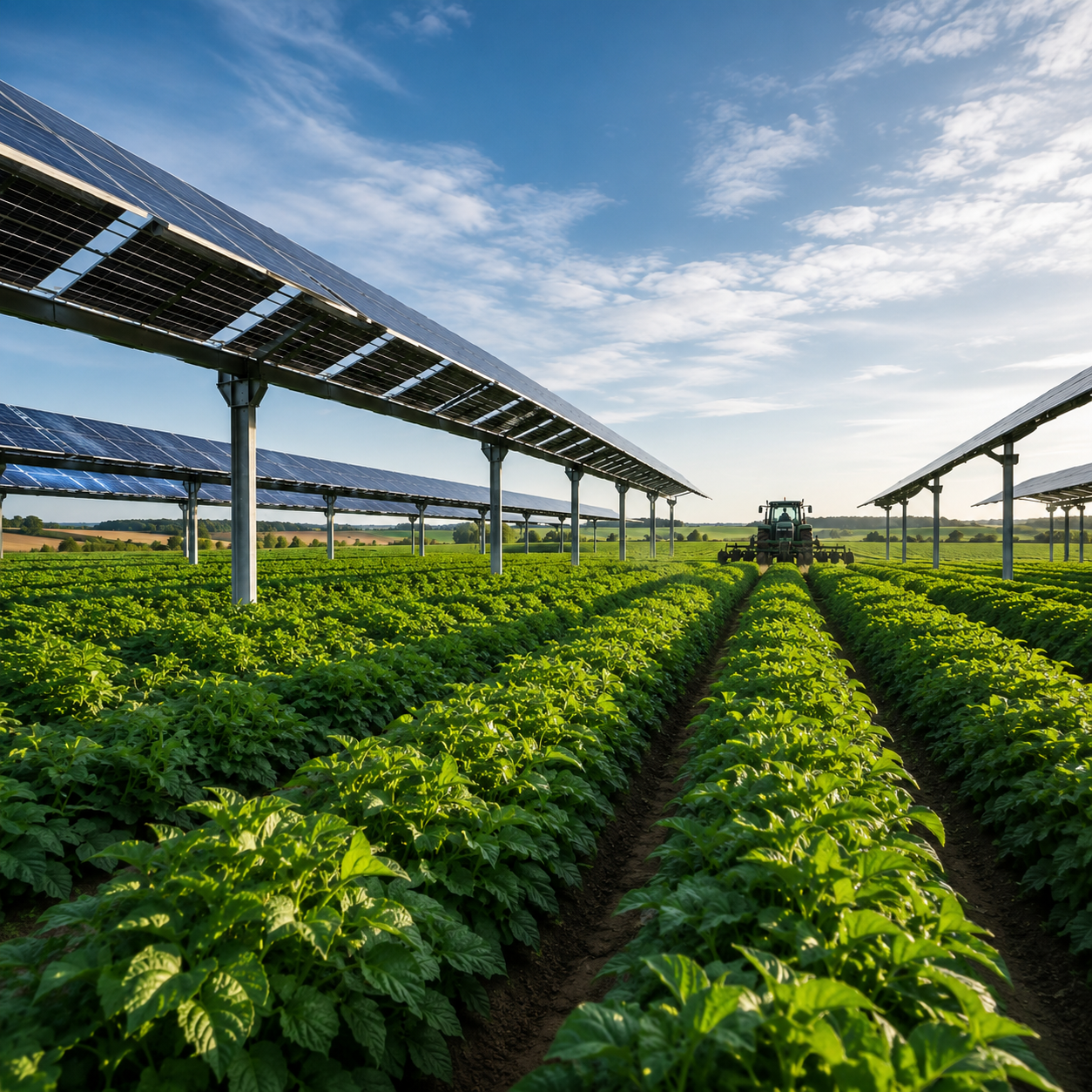
Austin Gboru’s EnergyLane is developing agrivoltaic infrastructure that helps farms generate clean power while keeping land in production.
AUSTIN, TX, UNITED STATES, May 27, 2026 /EINPresswire.com/ — EnergyLane, a clean energy startup founded by Austin Gboru, is developing agrivoltaic infrastructure designed to let the same farmland produce both crops and solar power.
The company is entering a clean energy market facing a growing land-use challenge. Solar power needs space. Farming needs space. In agricultural regions where land is economically and politically sensitive, renewable energy development can quickly become a fight over what farmland is for.
EnergyLane is trying to build around that conflict. Its approach is based on agrivoltaics, the co-location of solar energy generation and agricultural production on the same land. Instead of replacing farms with conventional solar farms, EnergyLane’s model is designed to turn agricultural land into dual-use energy infrastructure.
The company’s proposed system, called the Sovereign Array, uses elevated solar structures designed to sit above active farmland. EnergyLane says the array is intended to allow farm equipment to operate underneath while creating crop-specific shading conditions below. The startup is also developing EnergyLane OS, a software layer meant to manage the relationship between the farm, solar array and grid by monitoring crop conditions, soil data, weather conditions and energy export.
EnergyLane’s first market focus is Prince Edward Island, where farmland preservation, potato production and net-zero policy intersect. PEI has set a target of reaching net zero by 2040, while its potato sector remains one of the Island’s most important economic engines. EnergyLane sees the province as a natural test case for agrivoltaic infrastructure because it needs more clean power while protecting farmland that cannot be treated as empty space.
The company’s pitch is that solar infrastructure should work with farmers, not around them. EnergyLane is not trying to persuade farmers to stop farming. It is trying to make the airspace above farmland economically useful while keeping the land itself in production.
The technical challenge is significant. Agrivoltaics is not simply a matter of placing panels above crops. A bankable system must satisfy farmers, utilities, permitting authorities, financiers, insurers and agronomists. It has to survive weather conditions, maintain equipment access, produce reliable electricity and prove that crop performance can hold up across growing seasons.
EnergyLane’s business model appears to sit between project development, grid infrastructure and farm-income generation. If the model works, farmers keep producing crops, the grid receives renewable power and EnergyLane captures value by developing, operating or enabling the infrastructure layer.
Gboru’s path into agrivoltaics is unusual. Before EnergyLane, he was known for NearSwipe, a fintech company tied to NFC-enabled smart identity cards and contactless payments. NearSwipe later won FirstBank’s Fintech Innovators Pitch Programme, according to reports, receiving 10 million naira as the overall winner.
NearSwipe was about digital access: identity, payments and institutional infrastructure. EnergyLane is about physical access: land, electricity, agriculture and grid resilience. The connection is infrastructure. One company deals with how people move through identity and financial systems; the other deals with how farmland moves through the energy transition.
Gboru is expected to begin the Master of Cleantech Leadership and Transformation program at the University of Prince Edward Island in the fall, placing EnergyLane’s development within a policy and agricultural environment where the problem it is trying to solve is visible.
EnergyLane remains early-stage, and its next phase will determine whether it becomes a real infrastructure startup. The company needs field validation, farmer partnerships, engineering proof, utility engagement, permitting pathways and capital.
But the market question EnergyLane is asking is direct: what happens when solar deployment moves from empty-land thinking to agricultural-system thinking?
EnergyLane’s bet is that farmland does not have to be sacrificed for solar power. It can become part of the energy system itself. If Gboru is right, the future of solar in agricultural regions may not look like panels replacing fields. It may look like panels rising above them.
Press
EnergyLane Inc.
email us here
Legal Disclaimer:
EIN Presswire provides this news content “as is” without warranty of any kind. We do not accept any responsibility or liability
for the accuracy, content, images, videos, licenses, completeness, legality, or reliability of the information contained in this
article. If you have any complaints or copyright issues related to this article, kindly contact the author above.

Media gallery