Key Takeaways
- Nearly 65% of Africa’s productive land is affected by degradation, according to UNCCD estimates.
- Soil erosion and vegetation loss reduce groundwater recharge and worsen water scarcity.
- Rural communities often face interconnected challenges involving agriculture, education, health, and water access.
- Long-term clean water funding increasingly focuses on sustainable infrastructure and land regeneration together.
Across large parts of sub-Saharan Africa, water scarcity is no longer viewed solely as an infrastructure problem. Environmental experts, humanitarian organizations, and clean water funding groups are increasingly linking the crisis to accelerating land degradation, declining soil health, and ecosystem instability. As a result, solar-powered wells, groundwater restoration initiatives, and land regeneration programs are becoming a growing focus for nonprofit organizations and philanthropic funding efforts.
Bellingham, WA-based nonprofit organization Synergy Heals, which supports clean water wells and land regeneration initiatives in rural West Africa, notes that long-term water access solutions increasingly focus on environmental restoration alongside infrastructure development.
Why Land Degradation Has Become One of Africa’s Biggest Water Challenges
Land degradation refers to the deterioration of soil quality and ecosystem productivity caused by deforestation, overgrazing, unsustainable farming practices, drought, and climate pressures. While the issue is often discussed in agricultural terms, its impact on water systems may be even more severe.
According to figures cited by the United Nations Convention to Combat Desertification (UNCCD), nearly 65% of Africa’s productive land is degraded. This environmental decline reduces the soil’s ability to absorb rainfall, replenish aquifers, and retain moisture during dry periods.
Healthy soil acts like a natural sponge. It slows runoff, filters groundwater, and supports vegetation capable of stabilizing local water cycles. Once erosion strips away topsoil and plant life disappears, rainwater runs off more rapidly instead of replenishing underground reserves. Rivers dry faster, aquifers weaken, and communities become increasingly dependent on unsafe or distant water sources.
Left unchecked, it becomes a cycle that grows progressively harder to reverse.
How Water Scarcity Impacts Rural Communities Beyond Drinking Water
The effects of water scarcity extend far beyond household hydration needs. In many rural regions across Africa, access to water directly influences agriculture, public health, education, sanitation, and local economic activity.
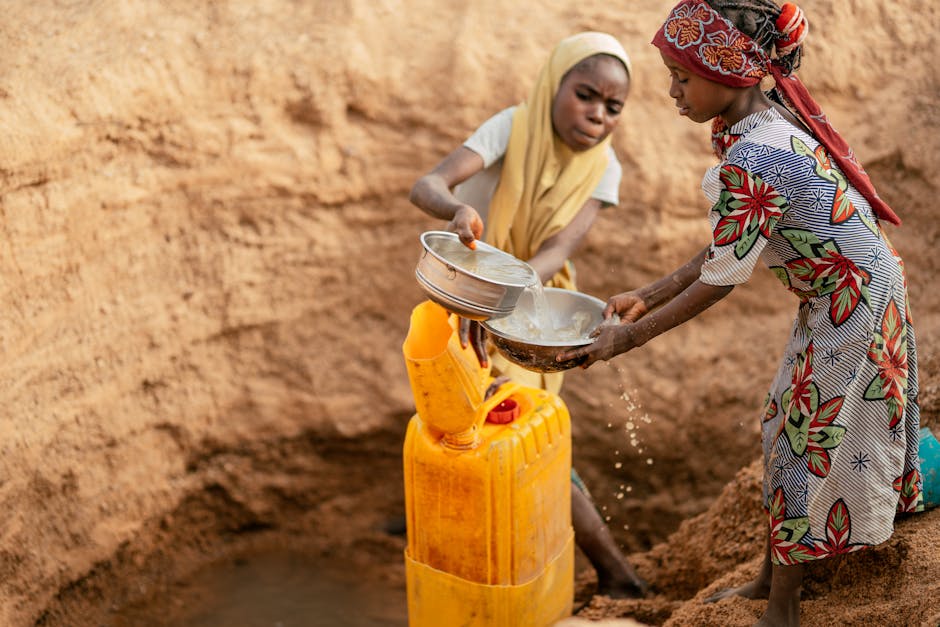
The World Health Organization and UNICEF have repeatedly noted that women and children in water-stressed regions spend significant portions of each day collecting water. In some areas, families walk several miles simply to reach contaminated sources shared by both people and livestock.
This daily burden has major secondary consequences.
Children who spend hours gathering water may miss school regularly or leave education entirely. Waterborne diseases increase pressure on already limited healthcare systems, while reduced irrigation and declining soil quality weaken agricultural productivity and food security. Livestock losses also become more common during prolonged drought periods.
In regions where economies depend heavily on small-scale farming, land degradation and water scarcity can quickly undermine household stability.
Why Experts Are Focusing on Sustainable Water Infrastructure
Traditional short-term aid efforts have often struggled to create lasting improvements in remote rural communities. One recurring challenge is infrastructure sustainability.
Diesel-powered wells, for example, may become difficult to maintain due to fuel costs, broken supply chains, or unavailable replacement parts. Similarly, poorly planned water projects sometimes fail because surrounding ecosystems continue to degrade even after infrastructure installation.
This has contributed to growing interest in integrated approaches that combine clean water infrastructure with environmental restoration strategies.
Solar-powered wells are increasingly viewed as a more sustainable option because they reduce operating costs and dependence on fuel transportation networks. At the same time, land regeneration efforts — including reforestation, erosion control, soil restoration, and vegetation recovery — aim to improve long-term groundwater retention and watershed stability.
Rather than treating water scarcity as an isolated issue, many environmental experts now view it as part of a broader ecological system.
The Growing Role of Clean Water Funding and Philanthropy
Funding gaps remain one of the largest obstacles to improving water access across vulnerable regions.
The African Development Bank has estimated that Africa requires tens of billions of dollars annually to meet water and sanitation infrastructure needs. Yet many rural communities remain underserved due to limited public investment, geographic isolation, and logistical challenges.
As a result, nonprofit organizations, faith-based charities, philanthropic foundations, and community fundraising initiatives continue playing a major role in financing local water projects.
Importantly, donor priorities are also evolving. Many funding initiatives now emphasize measurable long-term outcomes rather than temporary relief alone. This includes supporting projects capable of improving groundwater sustainability, agricultural resilience, and local self-sufficiency over time.
GPS verification, impact reporting, solar infrastructure, and community-managed maintenance systems are also becoming more common as donors seek greater transparency and accountability.
Why Land Restoration and Water Access Must Be Addressed Together
One of the biggest misconceptions surrounding water scarcity is the idea that drilling additional wells alone can solve the problem indefinitely.
Without healthy surrounding ecosystems, groundwater reserves may continue declining faster than they can recover. Degraded land reduces rainfall absorption, increases runoff, and weakens natural aquifer recharge systems. Over time, this places increasing pressure on existing wells and water infrastructure.
Environmental restoration efforts, therefore, play a critical role in long-term water security.
Rebuilding vegetation cover, improving soil stability, and restoring degraded landscapes can strengthen water retention capacity while reducing erosion and drought vulnerability. Combined with sustainable infrastructure such as solar-powered wells, these efforts may help rural communities build greater resilience against future climate and environmental pressures.
As environmental pressures continue reshaping large parts of sub-Saharan Africa, the connection between healthy land systems and clean water access is becoming increasingly difficult to ignore. For governments, nonprofits, and philanthropic organizations alike, long-term water security may ultimately depend on addressing both challenges together rather than treating them as separate crises.
SYNERGY HEALS
114 West Magnolia Street #400-135
SUITE #400-135
Bellingham
WA
98225
United States