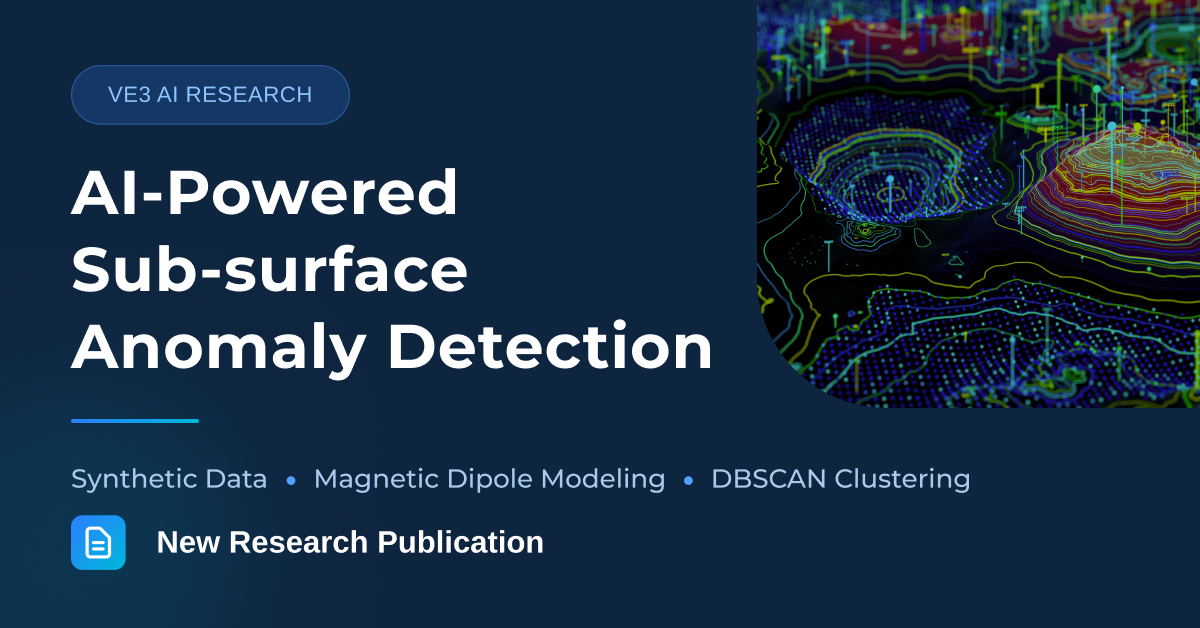
VE3 AI Research publishes a study on synthetic data, magnetic dipole modeling, and unsupervised AI for scalable anomaly detection.
LONDON, UNITED KINGDOM, June 17, 2026 /EINPresswire.com/ — VE3 AI Research has announced the publication of its latest research paper, “A Synthetic Data-Driven Framework for Sub-surface Anomaly Detection via Magnetic Dipole Modeling and DBSCAN,” advancing the application of synthetic data and artificial intelligence in geophysical analysis and anomaly detection.
The study investigates how physics-based simulation and unsupervised machine learning can be combined to identify subsurface magnetic anomalies without relying on large volumes of labeled training data. The approach addresses a long-standing challenge in geophysical exploration, marine surveying, infrastructure inspection, and environmental monitoring, where obtaining high-quality annotated datasets is often expensive, time-consuming, and operationally challenging.
The research introduces a framework that integrates magnetic dipole modeling, synthetic magnetometer data generation, statistical feature extraction, and Density-Based Spatial Clustering of Applications with Noise (DBSCAN) to identify coherent anomaly structures in complex environments. By leveraging synthetic data, the framework enables controlled experimentation and anomaly analysis while reducing dependence on traditional supervised learning methods.
Our research demonstrates how synthetic data can help overcome one of the key barriers to AI adoption in geophysical and subsurface analysis, the lack of accessible, high-quality labeled datasets. “By combining physics-based modeling with unsupervised learning techniques, we have developed a scalable framework that supports anomaly identification while creating a foundation for future AI-driven geospatial intelligence solutions.”
“One of the biggest challenges in subsurface anomaly detection is the limited availability of high-quality labeled datasets. This research demonstrates how synthetic data and unsupervised learning can provide a scalable foundation for anomaly identification while reducing dependence on annotated samples.”
– Nimitha U, AI Research Lead
The study evaluates clustering performance across varying dataset sizes, object configurations, environmental noise conditions, and survey parameters. Results demonstrate that adaptive clustering techniques can effectively separate anomaly and non-anomaly patterns while maintaining computational efficiency and scalability.
Potential applications of the research include:
• Geophysical exploration and mineral prospecting
• Marine and offshore surveying
• Buried infrastructure inspection
• Environmental monitoring
• Archaeological investigations
• Defence and security operations
The publication reflects VE3’s ongoing investment in applied artificial intelligence research, synthetic data innovation, geospatial intelligence, and advanced analytics. As organizations increasingly explore AI-powered approaches for subsurface sensing and anomaly detection, synthetic data is emerging as a critical enabler for model development, testing, validation, and operational readiness.
The research also highlights opportunities for future advancements through the integration of real-world survey data, advanced feature learning techniques, and hybrid machine learning models to further improve anomaly characterization and detection accuracy.
Read the full research paper: Data-Driven Buried Anomaly Detection Without Annotated Samples
Editorial Team
VE3
+44 20 4552 0840
press@ve3.global
Visit us on social media:
LinkedIn
YouTube
X
Facebook
Legal Disclaimer:
EIN Presswire provides this news content “as is” without warranty of any kind. We do not accept any responsibility or liability
for the accuracy, content, images, videos, licenses, completeness, legality, or reliability of the information contained in this
article. If you have any complaints or copyright issues related to this article, kindly contact the author above.

Media gallery