
Optimal Transit today unveiled Kraaken™, a family of standardized 10 MW, 20 MW, 50 MW and 100 MW self-powered maritime AI data center platforms designed to fundamentally change how hyperscale computing infrastructure is deployed. Artificial intelligence is rapidly becoming constrained by access to electricity, water, land, and permitting. Kraaken™ was designed to remove those constraints.
This press release features multimedia. View the full release here: https://www.businesswire.com/news/home/20260707919716/en/
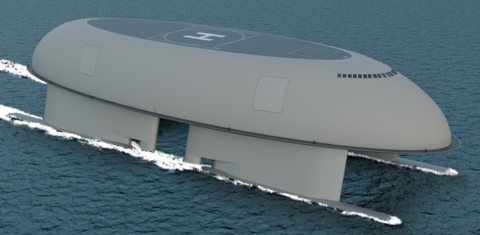
Optimal Transit Unveils Kraaken™: The World’s First Self-Powered Maritime AI Infrastructure Platform with CAPEX & OPEX Costs at a Fraction of Conventional Land-Based Facilities.
Unlike conventional AI data centers that depend upon the electrical grid—or dedicated power plants—to satisfy their enormous energy demands, Kraaken™ generates its own continuous electrical power by combining the thermal energy naturally stored in the ocean with waste heat produced by the data center itself. Through Optimal Transit’s patented multi-stage Digital Ocean Thermal (DOT) engine, waste heat that would otherwise be rejected becomes a valuable energy source. When combined with the ocean’s deep cold water, the Kraaken™ becomes the world’s most resilient utility that can operate continuously and enable the global transition to grid-immune AI and utility infrastructures.
The DOT engine incorporates multiple-stage Rankine cycle technology, enthalpy recovery logic, supercharging, and green ammonia (NH₃) synthesis to maximize thermal efficiency and provide reliable, carbon-free baseload electrical generation. The system is designed for continuous operation 365 days per year in marine environments ranging from equatorial waters to Arctic regions without requiring conventional fuel deliveries for data center operations.
Kraaken™ platforms are based on proven Small Waterplane Area Twin Hull (SWATH) vessel technology, providing exceptional stability for hyperscale computing while supporting continuous high-bandwidth optical and satellite communications. The modular platforms can operate either permanently moored offshore or independently at sea. If severe weather threatens, a platform can disconnect from its mooring and relocate under its own propulsion at speeds approaching 16 knots, allowing uninterrupted operation while avoiding major storms.
Distinct from many emerging offshore data center concepts that rely upon experimental wave energy systems or unproven marine technologies, Kraaken™ is designed around commercial-off-the-shelf (COTS) components with long operating histories in demanding industrial and maritime environments. The 10 MW, 20 MW, 50 MW and 100 MW platforms utilize commercially available gas turbines, marine propulsion systems, liquid-cooled modular data center infrastructure, and standardized shipbuilding practices, reducing technical risk while accelerating commercialization.
“Artificial intelligence is creating unprecedented demand for power, water and land,” said Scott Myers, President of Optimal Transit. “Kraaken™ takes a fundamentally different approach by moving data center infrastructure offshore and using proven marine engineering together with our patented Digital Ocean Thermal technology to produce continuous electrical power. Our innovation is not dependent on new scientific breakthroughs—it’s built on integrating commercially proven technologies into a standardized platform.”
According to industry estimates, construction of a conventional 100 MW AI data center typically requires between $900 million and $1.5 billion in infrastructure investment, excluding servers and GPUs, while annual operating costs for electricity, cooling, and facility infrastructure can range from $80 million to $150 million. Most projects continue to face lengthy and costly permitting processes and increasing public opposition due to power consumption, water usage, and environmental concerns
Optimal Transit estimates that the infrastructure cost of a standardized 100 MW Kraaken™ platform, excluding computing hardware, is less than $500 million, with projected annual operating expenses of $10 million to $20 million. Because Kraaken™ generates its own electrical power and cooling, the platform eliminates purchased electricity and conventional cooling infrastructure while spreading vessel depreciation over an expected 30-year operational life.
The Kraaken™ product family is designed around standardized modular platforms optimized for different computing missions. The 10/20 MW Kraaken™ is a 250-foot, 10,000-long-ton vessel configured for edge computing, sovereign cloud applications, and regional AI processing. The flagship 50/100 MW Kraaken™ is a 300-foot, 50,000-long-ton vessel optimized for hyperscale AI training and large language model applications. Both platforms incorporate liquid-cooled modular data center systems, enabling successive generations of computing hardware to be refreshed as technology evolves while leveraging the same long-life maritime platform.
Perhaps the Kraaken™’s most significant competitive advantage is its speed to deployment. The platform is built upon standardized SWATH hullforms, marine propulsion systems, and commercial equipment that the Optimal Transit team has developed, refined, and patented over decades of commercial and defense programs. By leveraging proven technologies and platform architectures, the company believes Kraaken™ can move from customer contract to operational service substantially faster than competing offshore data center concepts—and far faster than land-based versions.
As a vessel, rather than fixed industrial infrastructure, a completed Kraaken™ can begin generating revenue as soon as it leaves the shipyard and enters service. By standardizing the common-core platform architecture, every Kraaken™ becomes a repeat production order rather than a one-off engineering project, reducing technical risk, shortening construction schedules, and supporting an estimated operational payback period of three to four years.
Over the next nine months, proceeds from Optimal Transit’s ongoing Series A financing are expected to fund completion of American Bureau of Shipping (ABS)-ready engineering drawings for the 20 MW and 100 MW Kraaken™ platforms, together with comprehensive digital twin validation of the patented Digital Ocean Thermal (DOT) engine. Subject to successful completion of the Series B financing planned for 2027, the company intends to establish standardized production capable of delivering up to 20 Kraaken™ 100 MW platforms annually through qualified shipyards worldwide. Each platform is projected to represent approximately $400 million in infrastructure value, excluding servers and GPU hardware.
While Kraaken™ was initially conceived as a new class of offshore AI data center, Optimal Transit believes the platform represents the foundation for a much broader category of maritime infrastructure supporting the emerging Blue Economy. The Kraaken™ family of modular designs can provide secure computing, electrical power generation, communications infrastructure, desalinated water production, and other critical services for governments, financial centers, military installations, utilities, and coastal industries.
With approximately 40 percent of the world’s population living within 60 miles of an ocean coastline, the company envisions networks of Kraaken™ platforms operating together as offshore Sovereign Power Parks. In addition to providing hyperscale AI computing capacity, each Sovereign Power Park could export approximately 35 percent of its continuous electrical generation to shore through quick-disconnect high-voltage power and fiber-optic umbilical systems, creating resilient offshore infrastructure for regional energy, information, and water security while preserving valuable coastal land resources.
“Artificial intelligence is becoming as strategically important as electricity itself,” Myers said. “The next generation of critical infrastructure will not simply be larger data centers—it will be standardized platforms that integrate sustainable computing, energy, communications, and resilience into a single system. We believe Kraaken™ is the first step toward that future.”
About Optimal Transit
Optimal Transit is the maritime technology partnership of InMar Technologies and OptiFuel Systems, bringing together more than a century of combined experience in advanced naval architecture, autonomous systems, and energy engineering. Optimal Transit is developing advanced maritime infrastructure technologies that combine proven commercial marine systems with proprietary energy conversion technologies to address global challenges in energy, computing, transportation, and offshore infrastructure. The company’s patented Digital Ocean Thermal (DOT) technology forms the foundation for a new generation of self-powered maritime platforms designed for commercial and government applications.
Learn more at www.OptimalTransit.com.
View source version on businesswire.com: https://www.businesswire.com/news/home/20260707919716/en/
Media gallery


