
AKITA, JP / ACCESS Newswire / September 30, 2026 / Underground tunnel construction is high-risk work. The interior is enclosed and dimly lit, with hidden hazards such as collapse and leakage of toxic and harmful gases. Coupled with limited communication, obstructed visibility, and complex terrain, traditional monitoring may leave blind spots and, in some cases, make it difficult to fully grasp actual conditions inside the tunnel. Akita Prefecture is in the Tohoku region of Japan, faces the Sea of Japan to the west, lies in a seismic zone, and receives heavy snowfall in winter, making local underground tunnel construction even more difficult and the working conditions more complex. During construction, teams must contend with regional challenges such as poor stratum stability, high humidity inside the tunnel, and sharp temperature fluctuations, further amplifying the pressure of safety control in tunnel construction.
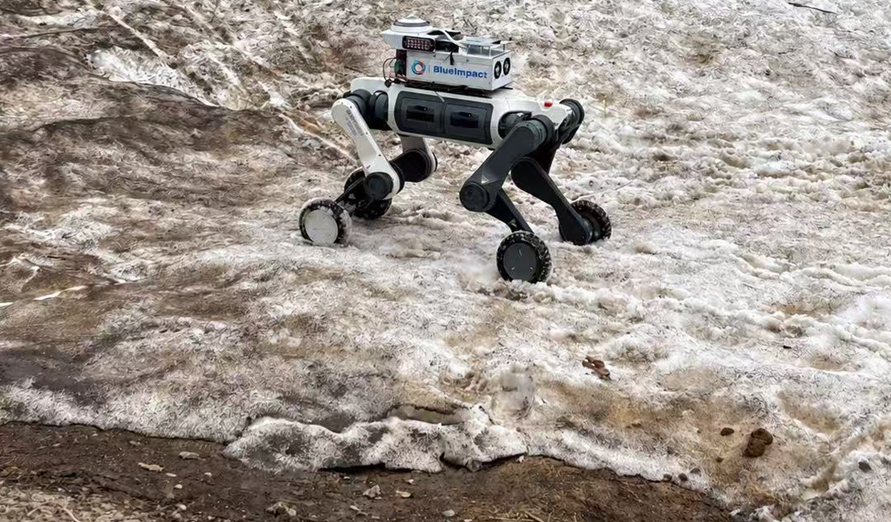
Faced with such harsh conditions, DEEP Robotics deployed its Lynx M20 Pro wheeled-legged robot in an underground tunnel under construction in Akita Prefecture, Japan. Targeting three industry challenges in enclosed, long-distance tunnels-personnel safety risks, limited on-site information acquisition, and the difficulty of integrating multiple technical systems-it conducted trials related to advance safety confirmation and remote perception for tunnel robots.
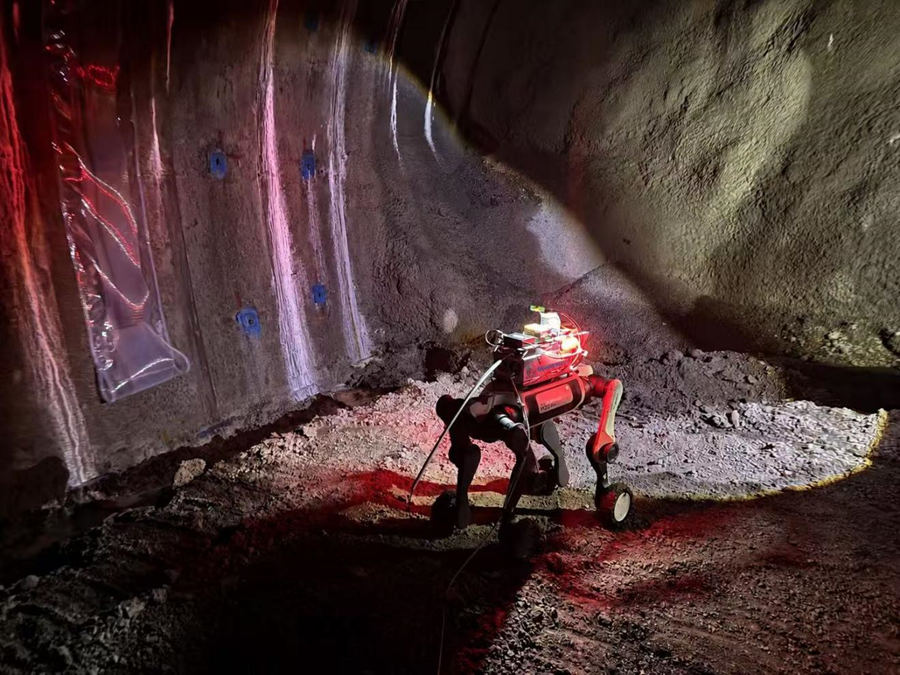
Enclosed, Dim, Long-Distance – Tunnels Are a Real Environment for Testing a Robot’s On-Site Deployment Capability
Tunnels under construction are characterized by enclosed, dim, and long-distance environments, and may also present operational constraints such as uneven road surfaces and communication difficulties in certain sections. Relying solely on fixed camera equipment or manual confirmation can, in some cases, make it difficult to obtain the required on-site information from a sufficient range before work begins. At the same time, if personnel are sent in first to survey the site, workers may be the first to face potential safety risks.
Against this backdrop, DEEP Robotics, together with its Japanese partner, carried out advance safety confirmation and remote perception trials using the Lynx M20 Pro wheeled-legged robot in an underground tunnel under construction in Japan-letting the robot obtain necessary information before humans enter. With its wide operating temperature range of -20°C to 55°C, IP66 industrial protection, and standardized expandable payload interfaces, the DEEP Robotics robot dog can carry operational payloads such as gas detection and 3D measurement equipment as needed. This explores having the robot dog undertake high-risk surveys and assist with pre-entry safety confirmation, reducing the frequency of personnel entering high-risk tunnels.
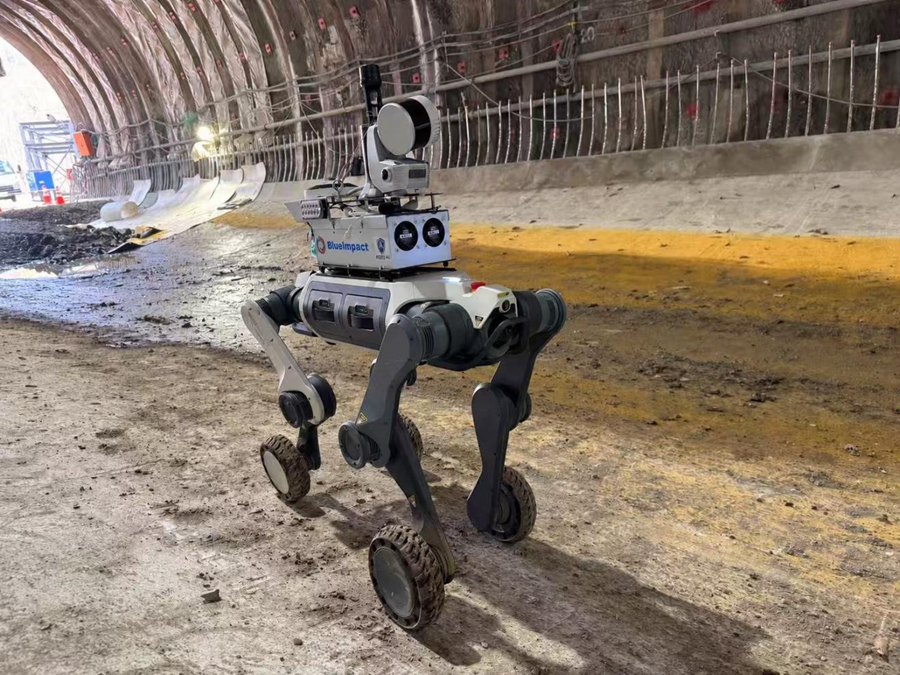
Robot First: Providing Another Way to “See the Site”
Tunnel rock masses can easily affect wireless communication, and deep sections and corners may also suffer from insufficient lighting and uneven road surfaces. Traditional fixed monitoring equipment is limited by installation positions, making it difficult to continuously cover all areas inside a tunnel. When both communication and passage conditions are constrained, how to enable personnel at the rear to assess conditions deep inside the tunnel is an important issue in on-site applications.
DEEP Robotics’ robot dog can transmit on-site information to the rear via onboard camera equipment and other means. With its traversability and payload expansion capabilities, it can also combine different sensors and measurement devices according to site conditions, providing a new way to acquire information in areas that previously required personnel to confirm first. The robot acquires information first, and personnel then confirm based on that information-thereby exploring a new on-site working method of “human-robot collaboration, each leveraging its strengths.”
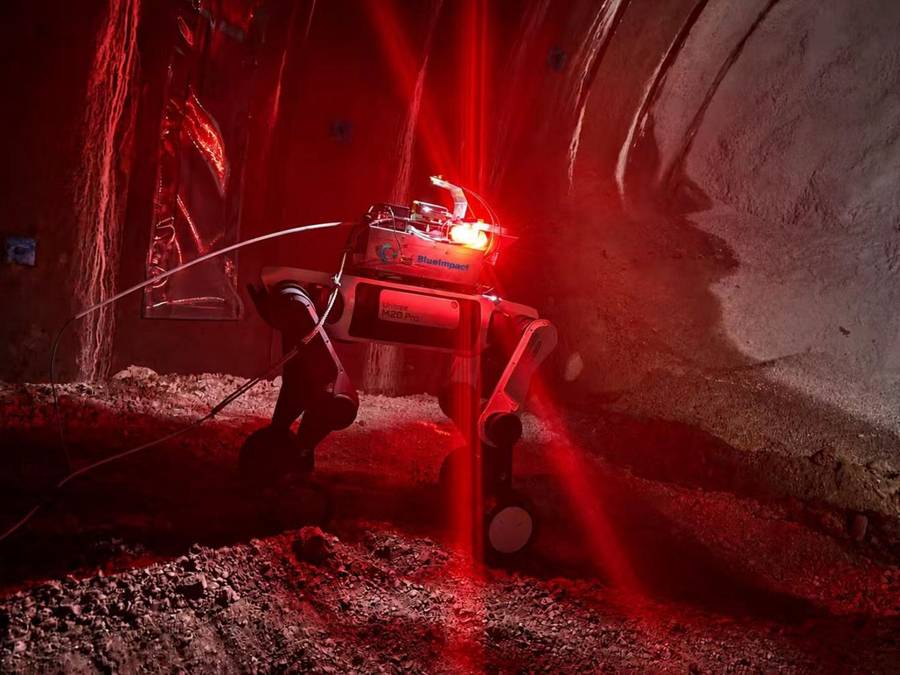
Communication, Perception, 3D Measurement – From “One Robot” to “One On-Site System”
In environments such as tunnels, simply bringing a high-performance robot to the site does not mean the application can be immediately deployed. For spaces with considerable depth, turns, and obstructions, it is necessary to comprehensively consider communication methods, clarify how imagery and sensor data are transmitted back to the rear, and determine which information can truly serve on-site judgment. Whether a robot can adapt to tunnel construction depends not only on the hardware itself but also on whether multiple technologies can be effectively “connected” in a real site.
Therefore, with the DEEP Robotics robot dog as the core mobile platform, the company combined elements such as communication, cameras and environmental perception, 3D measurement, data transmission, on-site work processes, and on-site safety management to advance systematic verification at an infrastructure construction site.
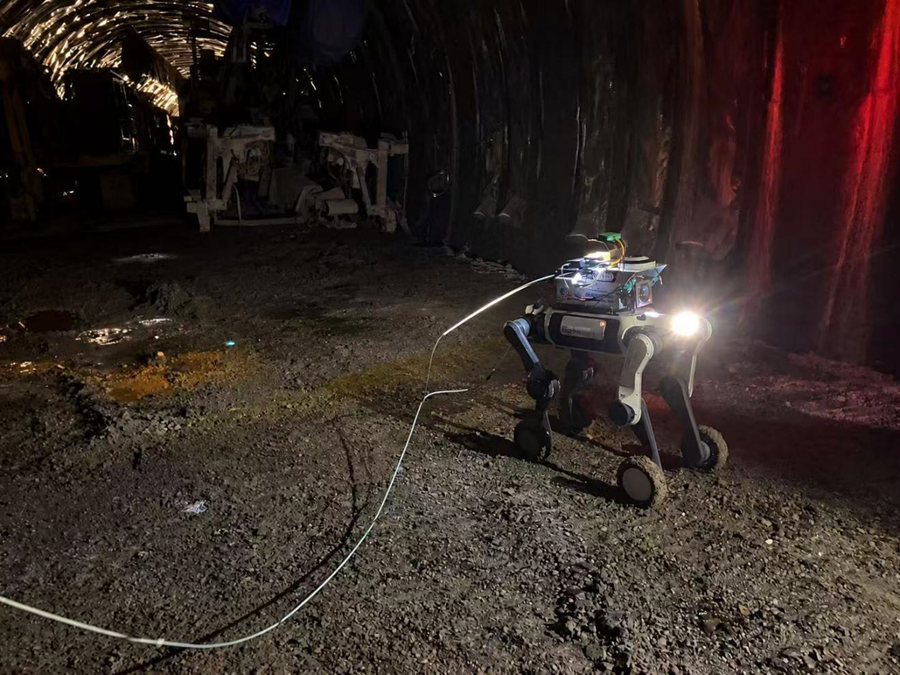
On-Site Field Testing Drives Technological Iteration
Many problems only surface when put into real working conditions. The various constraints and special conditions on site precisely constitute an important basis for iterative optimization of robot functions and operating plans.
At present, the Japanese tunnel-under-construction project is completing phased verification of basic capabilities such as robot dog walking, remote control, communication, image acquisition, and environmental measurement. On this basis, DEEP Robotics will distill corresponding technical topics from on-site working conditions and further iterate toward higher-level operational capabilities.
From Empirical Validation to Standardization: Delivering a International Solution for Dangerous and Complex Environments
Through on-site verification in a Japanese tunnel under construction, DEEP Robotics and its partners have broadened the application boundaries of quadruped robots at construction sites. Grounded in actual working conditions, they have tackled technical difficulties and achieved bidirectional iteration of products and technologies. As a leader in embodied AI technological innovation and industry applications, DEEP Robotics ranked first globally in quadruped robot industry applications in 2025. It currently has more than 1,200 real industry deployment scenarios. Relying on project practices across 45 countries and regions worldwide, it has accumulated mature on-site adaptation capabilities.
The capabilities verified in this tunnel-enclosed-space traversal, long-distance communication, remote perception, and 3D measurement-are equally applicable to high-risk operational scenarios such as underground facilities, industrial plants, and disaster response. Leveraging the flexible traversal and multi-robot collaboration advantages of quadruped robots, DEEP Robotics continues to refine a replicable paradigm for underground space operation and survey, delivering reusable industry solutions both domestically and internationally. With domestically developed intelligent equipment, it brings China’s smart inspection solutions to high-risk worksites worldwide, supporting the safety transformation of high-risk on-site operations.
Media Contact
Company: DEEP Robotics
Contact: Vivian Chen
Email: chenlingjia@deeprobotics.cn
Website: https://www.deeprobotics.cn/en
SOURCE: DEEP Robotics
View the original press release on ACCESS Newswire


