
SEATTLE, WA / ACCESS Newswire / October 27, 2026 / ECO-Lipak, a brand of sustainable dining and household products, recently completed the addition and update of certification and testing documentation for select products, officially established a dedicated B2B customer service team, and announced plans to further optimize its U.S. warehousing and distribution network. These adjustments span multiple areas, including product quality management, corporate procurement services, and logistics operations, and are aimed at enhancing the brand’s product and service system in the U.S. market. As consumer focus on sustainable products gradually shifts from environmental attributes to safety, reliability, and practical performance, ECO-Lipak will continue to leverage its diverse product portfolio-which includes catering supplies, everyday paper products, and household cleaning supplies-to strengthen product information transparency and usability management, while providing commercial customers with more comprehensive procurement and supply support.
Consumer concern about sustainable products is extending to product safety
Eco-friendly materials are no longer the only consideration for consumers when choosing sustainable products; whether a product can be used safely and reliably in daily life is becoming a more specific purchasing requirement. A study by Rihn et al. (2025) found in a study of 1,304 U.S. consumers that, compared to disposable plates treated with PFAS, consumers preferred plant-based alternatives, and the provision of information on health risks further increased their willingness to pay. This finding reflects that the potential health impacts of materials are becoming a key consideration in consumer purchasing decisions.
A global circular economy consumer study released by the British Standards Institution (BSI, 2025) revealed that 56% of respondents lacked trust in the quality of such products, 51% had safety concerns, and 49% were worried about reliability. These figures indicate that consumers are not only concerned about whether products are made from eco-friendly materials; beyond their environmental attributes, they also place a high priority on whether products can be used reliably in everyday life.
These demands manifest differently across various usage scenarios. Food-contact products require heat resistance, oil resistance, and leak-proof properties; everyday paper products require attention to material quality and comfort of use; and household cleaning products must balance material selection, structural strength, and leak-proof performance. The material properties, manufacturing processes, and actual usage conditions of different products collectively influence consumers’ assessments of their safety and suitability.
From the Dining Table to Everyday Home Life, ECO-Lipak Expands the Use of Diverse Materials
ECO-Lipak’s current product portfolio spans catering supplies, everyday paper products, and household cleaning supplies. Made from materials such as sugarcane pulp, bamboo, PLA, and CPLA, the range includes dinner plates, bowls, takeout containers, cutlery, beverage cups, bamboo pulp toilet paper, and compostable trash bags. Based on the characteristics of different materials and actual usage conditions, the brand offers appropriate options for scenarios such as food contact, skin contact, and household cleaning.
A hot meal or a cold drink-seemingly ordinary daily meals-actually involve different food contact requirements. ECO-Lipak’s compostable plates are made from sugarcane pulp, balancing structural strength with oil resistance and leak-proof performance. The brand also offers products such as bowls, compartmentalized trays, takeout containers, and serving trays; some styles are microwave-safe and suitable for freezer storage, meeting diverse needs for food serving, heating, and preservation. CPLA cutlery and bamboo/wooden utensils suitable for hot foods, as well as PLA beverage cups designed for cold drinks, further expand the range of material options for various dining scenarios.
Compared to the brief contact during meals, everyday paper products such as toilet paper come into contact with human skin much more frequently, making material quality and comfort particularly important. In addition to softness and durability, consumers are also beginning to pay attention to raw material selection and the avoidance of unnecessary chemical additives. ECO-Lipak applies bamboo pulp to everyday paper products such as bamboo toilet paper, while prioritizing raw material selection and minimizing unnecessary chemical additives, ensuring that daily personal care balances comfort with material quality.
Household cleaning products face different usage requirements. In addition to material composition, trash bags must prevent health risks caused by tears or leaks during use. ECO-Lipak uses PLA-containing compostable materials in its compostable trash bags and incorporates reinforced seals, tear-resistant, and leak-proof designs to reduce the risk of tears and leaks during waste collection and transport.
From food contact to skin contact to household cleaning, ECO-Lipak’s diverse product portfolio conveys a clear philosophy: environmental sustainability is the starting point for material selection, while safety and practicality are the keys to integrating products into daily life. With holidays such as Thanksgiving, Christmas, and New Year’s approaching, family dinners, office celebrations, and holiday parties will drive a surge in demand for disposable items. From serving meals to cleaning up afterward, the varying performance requirements across different scenarios underscore the importance of making informed material choices.
ECO-Lipak Enhances Certification and Testing Documentation to Improve Product Information Transparency
Consumers’ assessments of product safety are based not only on actual usage experiences but also on whether a brand can provide clear, verifiable product information. A 2024 BSI survey of U.S. consumers revealed that 65% of respondents want clear, easily accessible information on environmental impact, and 76% are more likely to purchase products from companies whose environmental claims can be verified through evidence or certifications.
To further enhance the transparency and reliability of product information, ECO-Lipak has recently added and updated certain product certifications and testing documentation, including BPI and FSC certifications, as well as SGS test reports. Currently, the brand has obtained relevant certifications such as FSC, BPI, and ISO, and holds SGS test reports and certificates of compliance with the DIN EN 13432 standard, covering multiple aspects including raw material sourcing, environmental performance, compostability, and quality management. In addition, certain products have passed relevant high-temperature resistance tests and, depending on the specific product’s intended use, can be used for serving hot food, microwaving, or oven heating.
By enhancing its certification and testing documentation, ECO-Lipak has further strengthened the verifiability of its product information, providing consumers with clearer guidance on the material properties, safety-related characteristics, and usage conditions of different products.
ECO-Lipak Advances Business Services and Operational Upgrades in the U.S. Market
ECO-Lipak is further refining its business strategy in the U.S. market, prioritizing corporate customer service, warehousing and distribution, and product development as key areas for growth in the next phase. This plan not only focuses on expanding product categories but also reflects the brand’s commitment to long-term partnerships and stable supply for its business clients.
As a key initiative of this plan, ECO-Lipak has established a dedicated B2B customer service team to provide product consultations, sample support, bulk purchasing, and customization services to foodservice businesses, event planning companies, retailers, and distributors. Leveraging products such as sugarcane pulp tableware, bamboo and wood tableware, and CPLA tableware, the brand is further expanding its bulk supply of compostable utensils to meet diverse needs in foodservice operations, banquet events, and institutional procurement. In addition, ECO-Lipak offers wholesale compostable bags, further expanding the selection of everyday consumables available to commercial customers.
At the same time, ECO-Lipak plans to open additional warehouses in the United States to further expand its domestic warehousing coverage and optimize inventory allocation and distribution arrangements among existing warehouses. This expansion plan aims to shorten delivery distances in certain regions, improve supply stability and order fulfillment efficiency, and support both the daily restocking needs of commercial customers and bulk purchasing for large-scale events. The brand will also incorporate feedback from consumers and business customers to further refine its product categories and specifications, with a focus on practical performance characteristics such as heat resistance, oil resistance, leak-proofing, and structural stability.
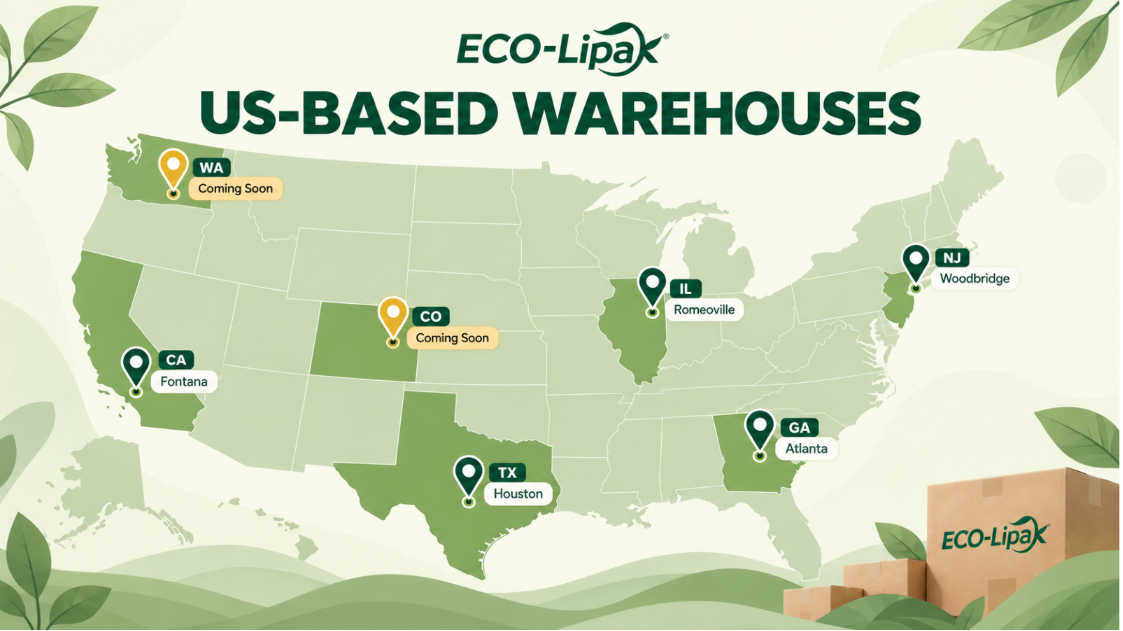
ECO-Lipak’s U.S. warehouse network spans California, Texas, Illinois, Georgia, and New Jersey, with new locations planned in Washington and Colorado to expand shipping coverage and provide faster, more reliable delivery.
ECO-Lipak’s Social Responsibility
For ECO-Lipak, brand responsibility extends beyond the selection of materials prior to product launch to include product information disclosure, actual use, and after-sales service. Ensuring that consumers understand the product’s intended use and that business customers receive accurate purchasing advice are both critical to building long-term trust in the brand. Moving forward, ECO-Lipak will continue to refine its product information and service systems, incorporating consumer safety, the right to know, and the actual user experience into the brand’s ongoing development strategy, so that sustainable products can better serve everyday life.
About ECO-Lipak
ECO-Lipak is a brand specializing in sustainable dining products and household goods. Guided by its brand philosophy of “Keep Your Food Away from Plastic,” it is committed to reducing reliance on traditional single-use plastics through the use of sustainable materials. The brand not only focuses on the eco-friendly properties of its materials but also prioritizes product safety when in contact with consumers, practical performance, and suitability for various applications, thereby promoting the integration of sustainability into everyday life. This philosophy is reflected in ECO-Lipak’s diverse product lineup, which includes sugarcane pulp plates, bowls, and takeout containers; bamboo and wood cutlery; beverage cups; bamboo pulp paper products; and compostable trash bags. The brand offers product options that balance environmental friendliness, safety, and practicality for household consumers, foodservice businesses, event planning companies, and institutional procurement clients.
Contact ECO-Lipak:
Daniel Morgan, Team Manager
ECO-Lipak Office
Website: https://ecolipak.com/
Email: service@ecolipak.com
Phone: +1 833-382-7669
Rihn, A. et al. (2025) ‘Consumer preferences for per- and polyfluoroalkyl substances versus bio-based treatments of disposable dinnerware: A discrete choice experiment’, Journal of Agricultural and Applied Economics, 57(4), pp. 656-672. Available at: https://doi.org/10.1017/aae.2025.10016
British Standards Institution (BSI) (2025) ‘Safety and quality fears preventing consumers from buying more sustainable products‘. 8 July. Available at: https://www.bsigroup.com/en-GB/insights-and-media/media-centre/press-releases/2025/july/safety-and-quality-fears-preventing-consumers-from-buying-more-sustainable-products/ (Accessed: 13 October 2026).
British Standards Institution (BSI) (2024) ‘Americans willing to shop more sustainably, BSI study finds’. 5 December. Available at: https://www.bsigroup.com/en-US/insights-and-media/media-center/press-releases/2024/december/sustainable-shopping-us-survey/ (Accessed: 14 October 2026).
Mintel (2025) US Trash Bags and Consumer Attitudes towards Garbage Report 2025. Available at: https://store.mintel.com/report/us-trash-bags-market-report (Accessed: 15 October 2026).
SOURCE: ECO-Lipak
View the original press release on ACCESS Newswire


